
Kvinnelige prester. Dialogen · Del 74
In September 2021 Rose Okeno became the first woman to lead a diocese in the Anglican Church of Kenya, a church that belongs to GAFCON. She answered our questions in writing from Butere in western Kenya.
Av Maria Solbak Årnes · Written answers from Bishop Rose Okeno, Diocese of Butere, Anglican Church of Kenya · 6 November 2026 · 13 November 2026
A calling of her own
MARIA Tell us briefly about yourself and your diocese.
I am Rose Okeno, Bishop of the Anglican Diocese of Butere in western Kenya. Our diocese serves communities whose lives are deeply connected to family, farming, trade, education, and the life of the Church. My ministry is centered on proclaiming the Gospel, nurturing faith, and serving God's people.
MARIA How did you first sense the call to ministry, and who walked with you along the way?
My calling developed through prayer, service, and participation in the life of the Church. My husband's ministry was part of our shared Christian journey, but I came to recognize my own personal calling from God. It was something I had to discern and respond to myself.
MARIA Were there times when being a woman made the path harder?
There were moments when I was conscious of cultural and traditional expectations about women's leadership. However, I remained convinced that my responsibility was to be faithful to God's calling rather than be limited by people's expectations.
Fakta
Rose Okeno was born in Eshibanga in Butere and holds a Bachelor of Theology from Kenya Methodist University (2007). Before she became bishop, she served as coordinator of the women's work, vicar general, the archbishop's commissary and archdeacon of Shikunga. She was consecrated and enthroned on 12 September 2021 by Archbishop Jackson Ole Sapit. She was the first woman elected diocesan bishop in the Anglican Church of Kenya, and the second woman bishop in that church, after Emily Onyango, who became assistant bishop of Bondo in January 2021. Sources: Wikipedia: Rose Okeno, NPR, 2021.
Being the first
MARIA What did your election in September 2021 mean to you?
It was a deeply humbling moment. I received it not as a personal achievement but as a responsibility to serve God's Church. I was also conscious that my election carried significance for many women and young girls who might now see new possibilities for their own service.
MARIA In 2018 GAFCON asked its member churches to wait with women bishops until there was wider agreement. How did you and your church think about that?
I recognize that there are different perspectives within the Anglican Communion on this matter. My election arose from the discernment and processes of the Diocese and the Church of Kenya. I have never understood my ministry as a confrontation with any Anglican body. My focus has always been to serve faithfully within the Church and respect the wider Anglican family.
MARIA Have you met people who found it hard to accept a woman as bishop, and how have you met them?
Like many leaders, I have encountered questions and differing opinions. I have responded through patience, prayer, dialogue, and service. I believe leadership is best demonstrated through faithfulness rather than arguments.
The Bible
MARIA What is the Bible to you, and how do you see the Holy Spirit's part in it?
The Bible is the inspired Word of God and the authoritative witness to God's revelation and saving work through Jesus Christ. I believe the Holy Spirit inspired its writers and continues to guide the Church in understanding and living out its message.
MARIA How do you guard your own reading of Scripture?
Humility, prayer, careful study, the guidance of the Holy Spirit, and the wisdom of the wider Church. I also believe Scripture must be read in its context and in the light of the whole biblical witness.
The texts
MARIA In 1 Timothy 2:13, Paul refers to creation when he writes that women should not teach. How do you read that passage?
I take Paul's teaching seriously and would not dismiss the passage. However, I believe Scripture must be read as a whole, considering its context and the wider witness of God's work through women in both the Old and New Testaments. We must avoid interpreting one passage in isolation from the rest of Scripture.
MARIA Jesus appointed twelve male apostles. What do you think that means?
The twelve had a particular significance in representing the twelve tribes of Israel. However, Jesus also welcomed women into his ministry, and women were among the first witnesses to his resurrection. I believe we must consider the whole Gospel witness when reflecting on ministry and leadership.
Tekstene det gjelder
1 Timoteus 2,12-13 (MANTELEN NT)
Men jeg tillater ikke en kvinne å undervise eller å utøve myndighet over en mann, men å være i stillhet. For Adam ble formet først, deretter Eva.
Markus 3,13-14 (MANTELEN NT)
Og han går opp på fjellet og kaller til seg dem han selv ville, og de gikk til ham. Og han utpekte tolv for at de skulle være sammen med ham, og for at han skulle sende dem ut for å forkynne
We must avoid interpreting one passage in isolation from the rest of Scripture.
Not an imported idea
MARIA Some say that women's ordination came to Africa from the West. How do you see your calling in the light of African Christianity?
I do not see my calling as an imported Western idea. It emerged from my faith, my understanding of Scripture, and the discernment of the Church in which I serve. African Christianity has its own rich theological heritage and capacity to discern God's calling within its context.
MARIA What does your church teach about marriage? Some argue that churches which ordain women will in time accept same-sex marriage. What do you think?
These are two distinct theological questions and should not automatically be treated as the same. The Anglican Church of Kenya upholds marriage as a covenant between a man and a woman, grounded in Scripture. Recognizing women's gifts and calling to ministry does not, in itself, determine the Church's teaching on marriage.
I do not see my calling as an imported Western idea.
Her people
MARIA What does it mean to your people to have a woman as their bishop?
I believe our people want a bishop who will walk with them, pray with them, and provide faithful leadership. My responsibility is to serve them, regardless of gender. I also hope my ministry encourages young women and girls to recognize that their gifts have a place in God's Church.
MARIA Where do you see the Gospel at work in your initiatives for young mothers, mental health, and justice?
I see the Gospel at work whenever we accompany people through their struggles and help restore dignity, hope, and community. Supporting young mothers, addressing mental health, and advocating for justice are expressions of Christ's love in practical ways.
Closing
MARIA Are there passages you find hard to hold together with your ministry as a bishop?
I recognize that these passages require careful interpretation, and I respect that Christians approach them differently. I seek to read them alongside the wider witness of Scripture and the examples of women whom God called and equipped for ministry.
MARIA What would you like those who see this differently to understand? And is there anything we should have asked?
I would encourage people to understand that my ministry is about responding faithfully to God's calling, not competing with anyone or challenging the Church. Perhaps the more important question is how we can faithfully use all the gifts God has given the Church in service of Christ and his people.
Portrett
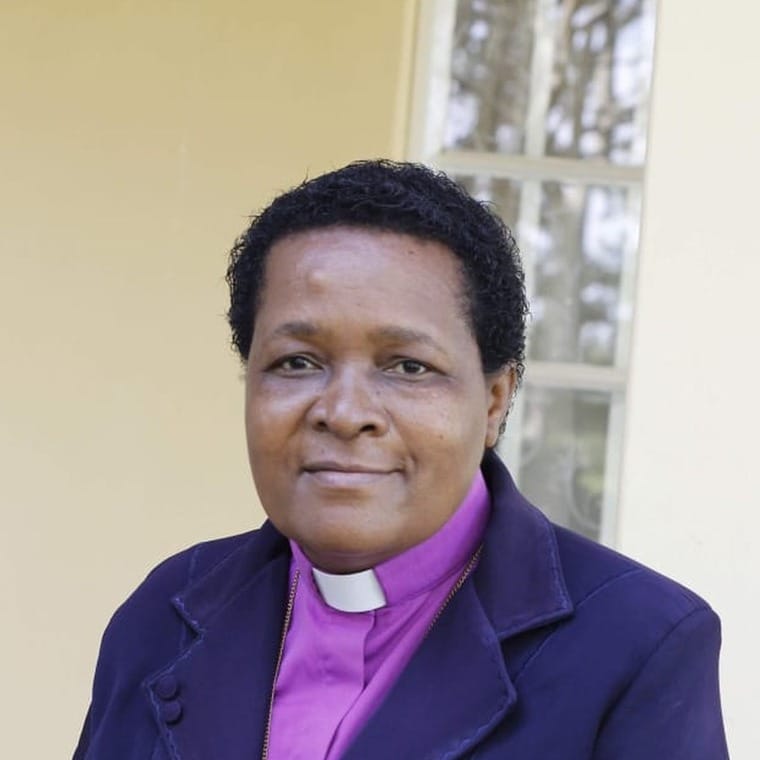
Bishop Rose Okeno, Diocese of Butere, Anglican Church of Kenya. Photo: Anne Akumu, Diocese of Butere.
Terskelen
Rose Okeno was consecrated Bishop of Butere in September 2021, the first woman to lead a diocese in the Anglican Church of Kenya. Her calling grew through prayer and service. She had to discern it herself, she writes, though her husband's ministry was part of the journey. She has met questions and answered with patience.
She reads Scripture as a whole. She takes Paul's words in First Timothy seriously and will not read them apart from the women God called in both testaments. The twelve stood for the tribes of Israel. Ordaining women and the teaching on marriage are two separate questions, she writes. Her church holds marriage to be between man and woman.
The editor takes one question with him. Paul gives creation as his reason, and she says she takes the passage seriously. What place does that reason from creation have in her reading of Scripture as a whole? We thank her for sharing this with us.