
Kvinnelige prester. Dialogen · Del 63
She grew up in American Pentecostal churches, where her father was an ordained minister, and has lived in Sweden since 2005. She could never be a member of a church with a woman pastor, she says. She also calls it a secondary issue.
Av Maria Solbak Årnes · Video conversation with Cynthia Andersson, Sweden · 13 October 2026 · 26 October 2026
A construction company in Sweden
MARIA Why don't you start with telling me where you are in life right now and where you work?
I am 46 years old. I work at a construction company in Sweden called Skanska, which I think they have in Norway, too. So I work at a construction company. I work with, like, environmental things. Hållbarhet, miljö. I've been working there 10 years now.
My husband is Swedish. So we met in 2004 on a Christian dating website, actually. We met online and we started writing.
At that time, 2004, I was in college. I was living in North Carolina, which is on the east coast in the U.S. And my mother, she was turning 50, and she wanted to go to Sweden for her 50th birthday, because her morfar, like her mother's father, emigrated from Blekinge.
I really wanted to marry a Christian man. But just for fun one night after we bought the tickets to come to Sweden, I said, I wonder what's in Sweden. And Jan-Eric just popped up on the screen just like that. And so I sent him a message and we started writing.
That's how it started. Long story short, we fell in love. We got married. So we got married in 2005. I moved here to Sweden in the same year, 2005. We have two kids. And my mother lives with us now. After she retired, she moved here to Sweden too.
I really wanted to marry a Christian man.
A father in the Assemblies of God
MARIA You grew up in a Christian family then, I guess.
Yes, I did. My father, when I was a child, when my parents were still married, he was an ordained minister in the Assemblies of God. He was actually born and raised Jewish. But my father converted and became a Christian when I think he was 19 or something. My mother grew up in a Christian home.
So yes, I would say I was raised in a Christian home all the way from the beginning.
MARIA Were you a member of the same church that your father served in?
When we were kids, we went to an Assemblies of God church, but we went to other denominations too. When I was in high school, we moved to New Jersey, which was outside of New York. It was like a Pentecostal, very charismatic church. There was lots of speaking in tongues and, you know, extremely charismatic Pentecostal environment.
And then when I turned 18, graduated high school, my mom moved to North Carolina to be around her parents. And the church we went to there in Charlotte, North Carolina, it was a Church of God. So Protestant, charismatic. Not Catholic, not Orthodox, not Lutheran, but more what you might call evangelical, kind of Protestant, charismatic type environments.
Fakta
The Assemblies of God is one of the largest Pentecostal fellowships in the United States. Its position paper on women in ministerial leadership, adopted by the General Presbytery in August 2025, states that «since the earliest days of the Fellowship, spiritual gifting has been clear in the ministries of women», and that women have served as pastors, missionaries, teachers and evangelists. Source: Assemblies of God, Women in Ministerial Leadership.
The elders and their wives
MARIA The view that women should not be ordained as ministers or priests, is that a view you have inherited from family, or have you figured this out yourself?
It's a very good question. I would say I've been thinking about this issue more or less my whole life, because I've seen so many different churches, different situations.
The church I went to when I was in high school, the head pastor was a man and there were elders, which were all men, but they quite often said the elders and their wives, the elders and their wives. So it was like the wives were, they weren't elders, but they just as well might have been almost. They clearly had a leadership. They clearly had a position. And there were even women guest speakers that spoke at that church.
And then when I moved to North Carolina, my mom had some friends, and they went to a church that was more of what we call like a black church, mostly African-American people. And there was a woman pastor, and they called her like the church mother, but she preached and she was definitely the pastor. She was the leader. And I remember asking my mom about that. My mom said, I don't think I would feel comfortable going there with a woman pastor. But at the same time, it doesn't bother me that she is the pastor.
And then when I came to Sweden and started going with my husband to his church, it was a smaller confessional Lutheran church, free church, like they say. So not connected in any way with the state church. And there they clearly did not ordain women, but they didn't either allow women to be on the church board, like kyrkoråd or kyrkostyrelse. And they didn't allow women to even vote in church meetings. Women could attend, but they couldn't vote.
And I remember thinking about the church I went to in North Carolina, where we got married. That church, they had maybe four or 5,000 people came for just a normal Sunday service. In that environment, when there's thousands of people, I don't think this issue is really anything I've thought about, honestly. But I came to this tiny little church in Sweden where there's maybe 15 to 20 adults, and half of them are unavailable to serve in certain capacities. It becomes a much more glaring issue to me.
So I remember asking questions about, well, where is the biblical support for this? What Bible verse, where does it say this in the Bible? And at some point in the last 20 years, that church changed its policy, where women could vote, but still could not be on the board or serve as pastors.
It becomes a much more glaring issue to me.
And then there's another Lutheran group, very similar to my husband's church, but they are quite connected to the Wisconsin Evangelical Lutheran Synod in America. They are very, very strict. Women cannot vote. Women cannot be in a board. Women cannot have authority over a man, period.
I found that very interesting, because I think theologically these two groups were quite similar in many ways, but they had come to different conclusions. How can people that are so theologically, doctrinally, quite similar, come to different conclusions?
And then I came into contact, maybe three years ago now, with Missionsprovinsen here in Sweden. They allow women to be in local church boards (kyrkoråd). They have central governing bodies. One is konsistoriet the other is called missionsrådet. Women are allowed to be in these. They have all kinds of different democratic groups, and women are involved all over the place, in a way that I have never seen. And they're also very, very traditionally, conservatively Lutheran. So that was very jarring to me. I thought, wow, how are they thinking about these things?
Missionsprovinsen has “läronämnden” and there it is only men. Which I think is totally biblical and correct by the way.
Fakta
Missionsprovinsen was constituted on 6 September 2003 as a Lutheran church province in Sweden. Its church order states that only a man is eligible as bishop, priest or preacher, while a deacon or deaconess may be «den man eller kvinna» who is called. In elections to the Missionsrådet, the order asks for a good distribution of men and women, laity and priests. The consistory has three clerical and three lay members besides the bishop, with no requirement as to sex. Questions of doctrine go to the läronämnd, which consists of the bishops, the dean and at least four priests elected by the college of priests; since only men are eligible as bishops and priests, its members are men. Source: Provinsordning, Missionsprovinsen, revised 27 September 2025.
Three questions first
So honestly, Maria, I have been thinking about these things and asking and reading for years and years. But I can tell you how I feel right now, on October 13th of 2026, anyway. I reserve the right to change my mind.
But right now, when people talk about this, can women be pastors, I feel like it's the wrong question. It's kind of like when people say, can you baptize babies? Really, the first question you should ask is, well, what is baptism? And then maybe you can start to talk about who you can baptize or when you can baptize.
I think there's more like three other questions you have to ask before you can ask that question. I would say the first question is, what do you believe about the Bible? That's really question number one. Do you believe that the Bible really is God's word, that the Bible is an authority?
Because I've met other people that call themselves Christians here, but don't really believe the Bible is an authority, and don't really believe the Bible is God's word. Well, then I don't see any common ground for us to even start to have a conversation.
If the Bible is God's word, then whatever the Bible says, that's something that we should follow. And not only follow it, but champion it and say, this is God's perfect will. This is the user manual. This is the instruction manual. So even if it's something I don't like or something I don't understand, you can't just say, well, then the Bible's wrong. In that case, we have to keep talking about it and keep reading and keep studying and keep praying.
I reserve the right to change my mind.
MARIA I was going to ask you the same thing.
Yes, I believe the Bible is absolutely God's word. And there is nothing else that we can base anything on. I don't believe, like the Catholics believe, that you have the Bible, and then you have actually the church, and what the church says is maybe even more important, or at least as important as the Bible. No, the Bible is the final authority.
So if we agree on that, then I would want to ask, what do you believe about men and women? Because people start talking about women pastors, but the Bible talks about men and women. God created Adam and Eve. The Bible talks about husbands and wives. The Bible talks about mothers and fathers.
I've talked to some Christians that I would say are quite patriarchal. They believe that all women should submit to all men at all times in all situations. A woman shouldn't be president. A woman shouldn't be prime minister. And then I've talked to other Christians that believe that no, we're all one. There is no male or female. And you have these two extremes, and then you have everything in between.
No, the Bible is the final authority.
After reading the first draft, she wrote to us with the three questions.
My three questions were (1) are you saved? born again? Truly a Christian (2) what do you believe about the Bible? (3) what do you believe about women and men?
I meant that I don't think there is any constructive conversation to have about the issue of women pastors if the person I am talking to is not saved/born again and has rejected the Bible as the authoritative word of God. Not the Bible "contains" the word of God. No, the Bible IS the Word of God! If not, then I don't think "should women be pastors" is a relevant topic for that person. First, they need to get saved (confess their sins and receive forgiveness and trust in Christ for salvation) if they have not already and then they need to study the basis for the authority of the Bible as God's word. That would be priority number one for that person.
What my mother told me
MARIA But what's your answer to the second one?
My mother, when I was a teenager, she was divorced. And so she basically raised us as a single mother. And she told me many times as a teenager, you need to understand that this is not God's perfect will. This is not God's best for any of us. The fact that I have to be in charge and run the household and be mother and father. This is not what it was meant to be.
She said, as a Christian woman, you do not have to submit to all men in all situations. But the Bible very clearly teaches that wives, you should submit to your husbands. So before you get into anything serious, you need to ask yourself, is this a man that I can respect, that I can submit to him, submit to his leadership? Like they say in Swedish, underordna.
And I have to say, I don't see that as a problem at all. Especially when you have a husband that loves you as Christ loved the church, loves you sacrificially, and takes care of you and protects you with a servant leadership. It's no problem to submit to a man like that.
Before sin came into the world, Adam and Eve had a perfect relationship with no tension. Those roles of men and women go all the way back to creation. It was sin that came into the world that made those roles difficult. Adam and Eve both sinned, but God came to Adam first. And what did Adam say? He tried to blame his wife.
And then Paul gave instructions, and he told the men, love your wives. And he told the wives, submit to your husbands. He didn't have to tell the wives, wives, love your husbands. And he did not say to the men, make sure that your wives submit to you. He said, you need to love your wives. So that also points to the areas where we struggle as men and women.
Tekstene det gjelder
Efeserne 5,22-25 (MANTELEN NT)
Dere koner, underordne dere deres egne menn som overfor Herren. For mannen er konens hode, likesom også Kristus er menighetens hode; og han selv er kroppens frelser. Men likesom menigheten underordner seg Kristus, slik skal også konene underordne seg sine egne menn i alle ting. Dere menn, elsk deres egne koner, likesom også Kristus elsket menigheten og overga seg selv for den,
It's no problem to submit to a man like that.
President and vice president
MARIA Many of the women I have spoken to struggle to see where in the creation story this submission arrangement is made by God. Some interpret that this is just the feminine and masculine side of man, and who came first and second doesn't tell us anything.
Well, I guess also then you have to ask yourself, what do they mean by the word submit? Even underordna in Swedish, it sounds old-fashioned, it sounds almost abusive. But I would say that word does not mean like master and slave. It means more like president and vice president.
I don't like Trump. Let me just say that. But just to use it as an example, President Trump is the president of the United States, and the vice president is J.D. Vance. And I don't think anybody would say that J.D. Vance being the vice president is some type of a servant, slave, belittled position at all. They clearly have different roles. He is not the president. He is the vice president. And he has a lot of authority and he is respected.
And when God said, I'm going to make a helper suitable, that word in the Old Testament, helper, it's the same word that's used to describe God in the Psalms, when it says God is a very present help. So God himself is described with that same word that he described the woman as. So it's not at all belittling.
I think it has taken on that unfortunate label, maybe because historically men have been abusive to women and they have abused their power and authority. Women have had to fight for things like the right to vote. All kinds of feminism wouldn't even exist in the world, if all men were loving their wives as Christ loved the church, if they treated women as co-heirs, if they treated women as God's precious creation, created in the image of God. They have not treated women correctly. And that's why feminism and all these things even exist, I would say.
But that same argument, you could say, like for example government. There are governments, like in North Korea, that are terrible to their citizens. So therefore, all government is bad. You can't make that conclusion. Because some people have abused their power, it doesn't make government wrong. It means those people were wrong.
So I don't think the solution is to say, let's do away with men and women's roles, or let's do away with submission. As a woman, I am not called to make sure that my husband loves me. I'm called to submit. None of this gets fixed by pointing the finger at the other. You take up a mirror and look at yourself.
It means more like president and vice president.
The authority of Paul
MARIA When people don't think of Paul's letters as sacred, I am having trouble continuing the arguments. Why should they consider Paul's letters as a part of Holy Scripture, they ask. He didn't know Jesus. He wasn't one of the original disciples. He hasn't written any of the Gospels. They say that we should focus on Jesus and on the Gospels. And when I ask about Paul, they just say, that's just the culture.
Well, with that logic, if you can just explain away anything that you don't like, then what are you basing anything on?
MARIA It's a love message that Jesus has that's important, they say. You have to love your neighbor, and that's enough.
Well, love your neighbor. I mean, the Red Cross can say that. Any charity organization can say things like that. Then you might as well be Muslim or Hindu or Buddhist.
You cannot discuss a holy, inspired Word of God with people that are not born again. First you must come to the insight that I am a sinner, and Jesus died for my sins, and I need salvation. And when you become born again, when you repent and you receive God's grace and forgiveness, then you can have the Holy Spirit. Because you cannot understand the Bible without the Holy Spirit. You cannot study the Bible like a college textbook or some work of academia, or like a philosophy.
Well, love your neighbor. I mean, the Red Cross can say that.
MARIA They will not believe in a God that will send someone to eternal hell. One woman said that if it feels wrong or it makes someone hurt, it can't be from God, or I will not believe in such a God.
Who is God? God is good, God is just, God is righteous, and God is fair. And let's be honest, we all deserve hell. That's why Jesus came. Jesus did not come to take away the law, he came to fulfill the law. He took all of our sin on him, and we need to trust in him for salvation.
So it's not about God sending people to hell. God hasn't sent anyone to hell. He doesn't want anybody go to hell. In fact, he has sent out the life preserver. He sent out the lifeboat. All you have to do is believe, come to him and believe.
And it's very hard to think about people you love and care about going to hell. But God's ways are not our ways. If God was something that we could, with our human brain, understand and figure everything out, and have no questions, well, what kind of God would he be? God has revealed everything that we need to know. And some things you have to just leave in God's hands.
My son, when he was one year old, we took him to the barnavårdscentral. He was going to get his vaccinations. I could have looked at him and said, you're going to get a shot. It's going to hurt for maybe a few seconds, but this is going to help you. Would he have understood it? No. When the needle went into his leg, did he cry? Yes. And I comforted him.
Even if God came down from heaven and tried to explain everything to us, would we even understand it? It's so incredibly arrogant to think that God has to come down and explain himself to you.
He sent out the lifeboat.
Tekstene det gjelder
Romerne 10,9 (MANTELEN NT)
For hvis du bekjenner Herren Jesus med din munn og tror i ditt hjerte at Gud reiste ham opp fra de døde, skal du bli frelst.
Apostlenes gjerninger 16,31 (MANTELEN NT)
Og de sa: «Tro på Herren Jesus Kristus, og du skal bli frelst, du og huset ditt.»
Hierarchy everywhere
MARIA I asked one woman about this submission theme, if she could at least say that she would submit under God, that it is a hierarchy. And she said, I believe God meets me at this height. She wouldn't admit that there is a hierarchy.
We have hierarchy all over us, in our lives everywhere. When we go to work, there's bosses. And those bosses have bosses. In the society we have a prime minister, and we have politicians. In the homes, the parents are responsible for the children. The police have authority over us. And look at a society where there's no authority, where there's just anarchy and chaos. Those societies don't work well.
So it's not about power. It's also about taking care of things, about protecting. We have authority over our children, not because we're supposed to rule over them, but because we protect them, because we love them.
I think people take their own life experiences and try to make the Bible fit my experience and what I've seen and what I feel, instead of the other way around.
Tekstene det gjelder
Romerne 13,1 (MANTELEN NT)
Hver sjel skal underordne seg de overordnede myndighetene; for det finnes ingen myndighet som ikke er fra Gud, og de myndighetene som finnes, er innsatt av Gud.
MARIA But these women say they do believe in Jesus, and that he is the Son of God, and that he is coming with this love message.
Well, then they believe in him, but I guess it could be possible that they have received some bad teaching, or maybe just not enough teaching. I have the privilege of being raised by parents that really read and studied the Bible, and I don't take credit for that. I just happened to be born into a family like that.
There are many churches where they have been so influenced by the culture, they've allowed the culture to dictate, even in our faith and what to think about the Bible. It's very unpopular. It's countercultural to talk about women should submit, or not to marry homosexuals. And so I think some people are a little weak, and they don't want to stand in the uncomfortable, unpopular corner. And some people, I think, they just haven't really gotten good answers to their questions.
So maybe they mean well and they're sincere. But if you've really been born again, then you should want to know what the truth is. You should be able to handle having your arguments questioned, because at the end of the day, what if I'm wrong? Then I don't want to be wrong.
You should be able to handle having your arguments questioned, because at the end of the day, what if I'm wrong?
A secondary issue
MARIA These female pastors, they tell me that the theology isn't that important to them. It's the people they meet that's important, the meetings with two human beings, they say.
Well, I can tell you I have never felt, I think even if I was a man, I still don't feel that I would want to be a pastor. So I don't know what they're feeling, that they felt called.
If somebody is somewhere preaching the name of Jesus and they happen to be a woman, I would never contact someone or try and condemn them. I feel like I'm responsible for me. I could never join a church and be a member of a church with a woman pastor. But if somebody I know does, unless they specifically asked me, Cynthia, what do you think about this? I really want to know your opinion. Well, then I would give it to them. Otherwise I would never bring it up.
I believe that this issue of women pastors, I really believe it is a secondary issue. The much more important issues that we've talked about is, are you saved? Are you born again? And what do you believe about the authority of the Word of God? Those are much more important questions than should women be pastors.
I could never join a church and be a member of a church with a woman pastor.
The responsibility of the elder
MARIA Your view is being criticized for being cherry-picking. They say that we don't follow every single thing that the Old Testament is telling us to do. And then you can't just take this one sentence from Paul and say that this excludes half the population from becoming priests.
I would say these principles, you don't even need Paul to prove these principles. Let's say Paul's verses don't exist in the Bible. These principles are still there, because it goes all the way back to creation. Jesus chooses these 12 disciples, right?
In the Old Testament, in Swedish they say offerpräst. Det fanns ingen kvinnlig offerpräst. Det fanns inga kvinnliga apostlar. Ingen kvinnlig äldste. Men det fanns kvinnliga profeter. Kvinnliga diakoner. Kvinnliga domare. You have like Deborah. Hon var den enda kvinnliga domaren. Deborah dömde och profeterade offentligt. Hon hade ett visst ledarskap i mäns liv.
And I was thinking also of Hulda, in the Old Testament. Hon söktes upp av kungen för vägledning från Gud. Och det kan inte förklaras som ett nödfall, för att det saknades goda män. She existed historically the same time when Jeremiah was a prophet. So you cannot deny that God called and used women in a number of different ways in the Bible.
But this is what I think it comes down to. The thing that the Bible is excluding women from, the way I would describe it is this: Women may not have roles or functions that include doctrinal authority over what the congregation or church teaches, preaches and confesses. This includes the responsibility for sacraments also.
MARIA And the highest position, that's connecting the church to God, I think. If the apostles represent some position, that may be the position they represent.
Not only the position, but I would say also who is going to answer to God for what was said in that church, and for what was done and what was preached, what wasn't preached, how things were handled. Who is held responsible? This is a very, very burdensome calling. This is a heavy calling to be a pastor or a teacher. He will be responsible. He will answer to God for this.
So when Paul says, for example, the woman must be quiet, he was talking about interpreting prophecy. He was talking about being the responsible elder that would judge: is this prophecy from God? Is this the right interpretation? It was talking about a doctrinal teaching responsibility. It could not have meant the way WELS, Wisconsin, means it, that women should not have any authority ever over any man. Because then how do you explain Deborah? How do you explain Hulda? How do you explain, like you said, Priscilla and Aquila? How do you explain even Miriam in the Old Testament? She was a prophet. Why does God give these examples in the Bible, if women were meant to just shut up, sit down, be quiet, make the coffee and take care of the kids and nothing else?
This is a heavy calling to be a pastor or a teacher.
Men who do not step up
I'll tell you another reason, Maria, why I think there's so many women pastors, honestly. I think there's so many men that don't take their responsibility. They don't take responsibility for their families. They don't take responsibility for their wives. I have so many Christian female friends that are married to Christian men, and the women have to be the ones to say, let's have evening devotions. Let's read the Bible. Come on, we need to go to church on Sunday.
And I've sat in so many church meetings where they're desperately needing, we need another, can please somebody. And there's women sitting there who would be happy to do it, and we're not allowed. And yet there's men sitting there, and they don't step up. So I think that we would never have women pastors if men had stepped up, number one. And then the men that did step up didn't try to dominate and abuse and disrespect and mistreat women. So if men are upset about this, they need to look first at themselves.
You can just Google, can women be pastors? You'll get a hundred thousand things you can click on and read. But do the same Google search on, I'm a young man, how do I become a godly father or a godly husband? Where is all the content on that? My son is 18. Hopefully one day he'll get married and become a Christian father, a Christian husband. Where's all the teaching about how to help him to grow and to be a responsible man of God?
All the energy and time and money and space that is taken up on this issue, I would at least like to see the same amount of energy spent on the older men teaching and mentoring the younger men. How to love their wives, how to take care of their families, how to take responsibility in the church, how to take responsibility in society.
So I think that we would never have women pastors if men had stepped up, number one.
Scripture interprets Scripture
MARIA In Norwegian institutions that teach people about the Bible, they say the congregation was struggling with women chatting in church when there was a sermon going on, and they needed to be quiet. It's a letter from 2000 years ago between Paul and this congregation. And using it for anything else, they say, is like taking a conversation today from someone's phone and applying it 2000 years ahead in time.
I completely disagree, of course. This verse here: all Scripture is God-breathed and is useful for teaching, rebuking, correcting and training in righteousness. All Scripture.
MARIA But then they say that Paul sometimes writes that this is my words and what I think, and this is from God.
Yes, he does say that at one point, but that doesn't mean that we can totally ignore Paul.
Many people have taken this verse here, and they say, yeah, women should remain silent. And people read this verse and they go, oh, what in the world? That can't possibly be the Bible. But they say in Swedish: Skriften skall med Skriften uttolkas, en klassisk hermeneutisk princip inom kristen teologi. You know, like, enskilda bibelord inte ska läsas isolerat, utan alltid förstås i ljuset av Bibeln som helhet. So when you get to a difficult verse, you don't say, oh, that can't be. Then you have to go back and say, what does the Bible say about this? Go back to Genesis, from Genesis to Revelation.
This whole chapter is talking about good order and worship, which is also where they get the idea that the women were talking and chatting and disturbing the worship. But what I honestly believe this means is that they were prophesying. Two or three prophets should speak, and then the others should weigh carefully what is said. And then after that, it says women should remain silent.
So the way I currently understand it, somebody would give a prophecy. The leadership, the elders, or we might say the pastors judged the prophecy. There's all these different words in the Bible that are used interchangeably, elder, pastor, bishop, “episkopos”, “presbyteros”, Let’s just call them all elders for now. The elders decide, and they're held responsible. Not only do they have power, but they're held responsible before God for what the church teaches, believes and confesses. And this includes interpretation of prophecy. The women are not to take that authority and responsibility. That's how I understand that verse. Women be silent in terms of not stepping into roles of doctrinal authority.
Tekstene det gjelder
2 Timoteus 3,16 (MANTELEN NT)
All Skrift er innblåst av Gud og nyttig til lære, til irettesettelse, til rettelse og til oppdragelse i rettferdighet,
1 Korinter 14,29-35 (MANTELEN NT)
Og to eller tre profeter skal tale, og de andre skal bedømme. Men hvis noe blir åpenbart for en annen som sitter der, skal den første tie. For dere kan alle profetere, én om gangen, for at alle skal lære og alle bli oppmuntret. Og profetenes ånder underordner seg profetene. For Gud er ikke uordens Gud, men fredens, slik som i alle de helliges menigheter. Kvinnene deres skal tie i menighetene; for det er ikke tillatt dem å tale, men de skal underordne seg, slik også loven sier. Men hvis de ønsker å lære noe, skal de spørre sine egne menn hjemme; for det er skammelig for kvinner å tale i menigheten.
That's how I understand that verse.
MARIA They say that you can't take one part of the Bible, or one sentence, and interpret it outside of the historical context or the society and culture.
Well, there are certainly things. For example, the Bible talks about head coverings. Every woman who prays with her head uncovered dishonors her head. I have never had to cover my head when I went to church. But I was born in 1980, and I have not grown up in a culture where that was done. So you could say that was definitely something cultural. There are Christians today, some Christian women cover their head. Some don't.
Study to show yourself approved unto God, rightly dividing the word of truth. 2 Timothy 2:15. And so, yes, there are aspects of the Bible that you have to consider in their cultural context. But if they say, oh, this is just cultural. This was 2000 years ago. I would say, have you really studied that? What are you basing that conclusion on? Have you rightly divided the word of truth in this case? Skriften skall med Skriften uttolkas.
Tekstene det gjelder
2 Timoteus 2,15 (MANTELEN NT)
Vær ivrig etter å framstille deg selv godkjent for Gud, som en arbeider som ikke har noe å skamme seg over, og som behandler sannhetens ord rett.
A wife of noble character
MARIA They say it wouldn't be possible for him to say that a woman should be priest, because of the role as secondary citizens that women had in that time.
I don't think women were secondary citizens. Have you read Proverbs 31? A wife of noble character, who can find? Her worth is far more than rubies. Her husband has full confidence in her. If you read this whole chapter, this is a woman who provides for a family. She's a business owner. She's a businesswoman. She is respected. She speaks wisdom. She watches over the affairs of her household. This is not some second-class citizen.
Where did we ever get the idea that because there's something I was not called to do, that makes me a second-class citizen?
Women want to be president. They want to be CEOs. But women don't want to go to war. Do you want to look at all the men that died in wars? Do you want to go out to war and sleep in the mud and shoot people? If we're laying in bed at night and someone breaks into the house, a criminal, I want my husband to go over there and get him.
God created me a woman. It's a blessing to be a woman. It's a wonderful thing to be a woman. I don't want to be a man. I want to be a woman. And I want my husband to be a man.
You said you work at a school. You're a teacher. OK, so you have the principal, where they call the rector. What if everybody wanted to be rector and nobody wanted to be in the classroom and teach? How would the school function? And does that mean that the rector is better than you or smarter than you? No, it actually means they have more responsibility than you.
I can be pregnant. I can give birth. A man cannot do that. Should he be mad about that and say, God, why didn't you let me get pregnant and have babies? No, because you're a man and you're a woman. This is how God created us, and we have different callings. What is so strange about that?
It's a blessing to be a woman.
I have total compassion for somebody that says, these verses are very challenging to me. This is really, really hard for me. I just don't know about this. That's OK. That's OK. But to come to the conclusion, therefore, because this is hard for me, because I don't understand this, therefore it must not be true, I don't come to that conclusion.
I have total compassion for somebody that says, these verses are very challenging to me.
Building on sand
As Christians, do we want to think biblically? Do we want the Bible to be what we base anything on? Because once you take that out, what are you basing anything on? Yourself? And then you're building on sand. You're not building on rock anymore.
You need to have a foundation that's outside of your emotions and your life experience. If you talk about, well, that was Paul and that was 2000 years ago, then what's to say that 2026? Is that what we should be basing it on? Our experience now, and how life is today, and in Europe? Well, then you're also basing your opinions on your life experience.
MARIA One lady in America said that she believed that creation is still ongoing, and that society is moving towards God's perfect society all the time. So then 2026 is better than 2000 years ago.
There you go.
I believe there are true Christians that really believe. I can tell you my husband, his sister is a pastor. She's a female pastor, in Svenska Alliansmissionen. I've known this woman for 20 years. And I can tell you this woman loves Jesus. And she believes in the Bible. And she just has a different interpretation. She's received different teaching, and she's come to different conclusions. But I don't doubt that if we all die tonight, I would see her in heaven. I have no doubt.
And I can tell you this woman loves Jesus.
After reading the draft, she wrote to us about this passage.
When I said, "There you go," I meant once again, here is someone who seems to feel free to create their own theology rather than submit to the authority of Scripture. She has no biblical basis for those claims. Where does the Bible teach that creation is still ongoing? Where does the Bible teach that society is continually progressing toward God's perfect society?
So back to my questions: Is this person truly born again? What do they believe about the authority and sufficiency of Scripture – the Bible?
When I brought up my husband's sister, it was actually to make the opposite point. I was not saying that all women pastors are therefore not Christians or that they all reject the authority of God's Word. In my view, my husband's sister is different from the woman you mentioned. While I disagree with my husband's sister on certain issues, I do not see her as simply inventing theology that has no grounding in Scripture and I am completely convinced she is a true born again Christian.
My issue is specifically with people – men or women – who appear willing to make theological claims without demonstrating where those claims come from in the Bible. That is the distinction I was trying to make.
Near the end, her husband, who had been listening, came to the screen to say hello. «I've been talking in English the whole night,» she said. «I thought my little Swedish came out.»
Portrett
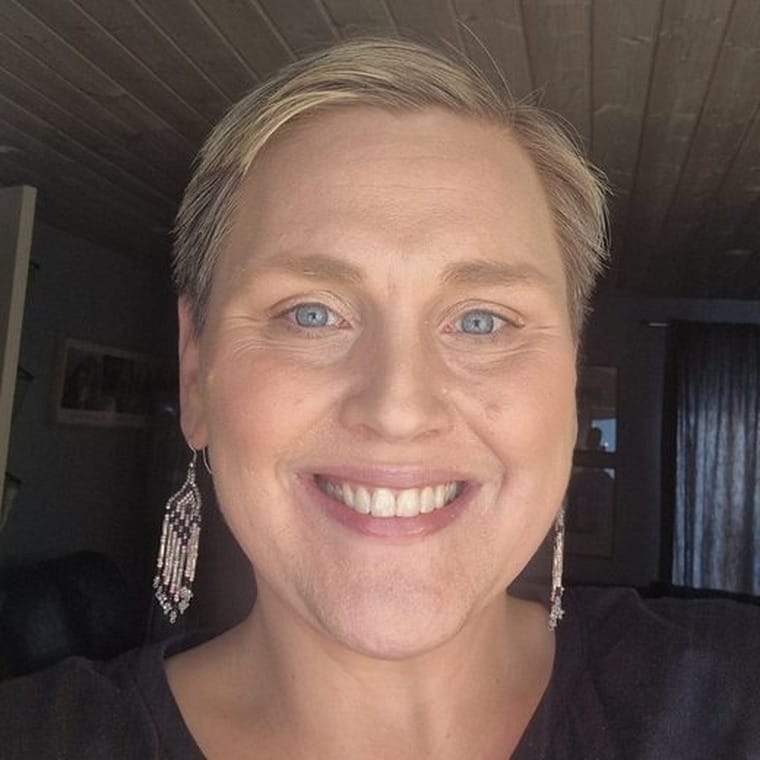
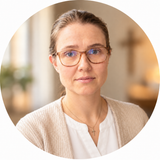
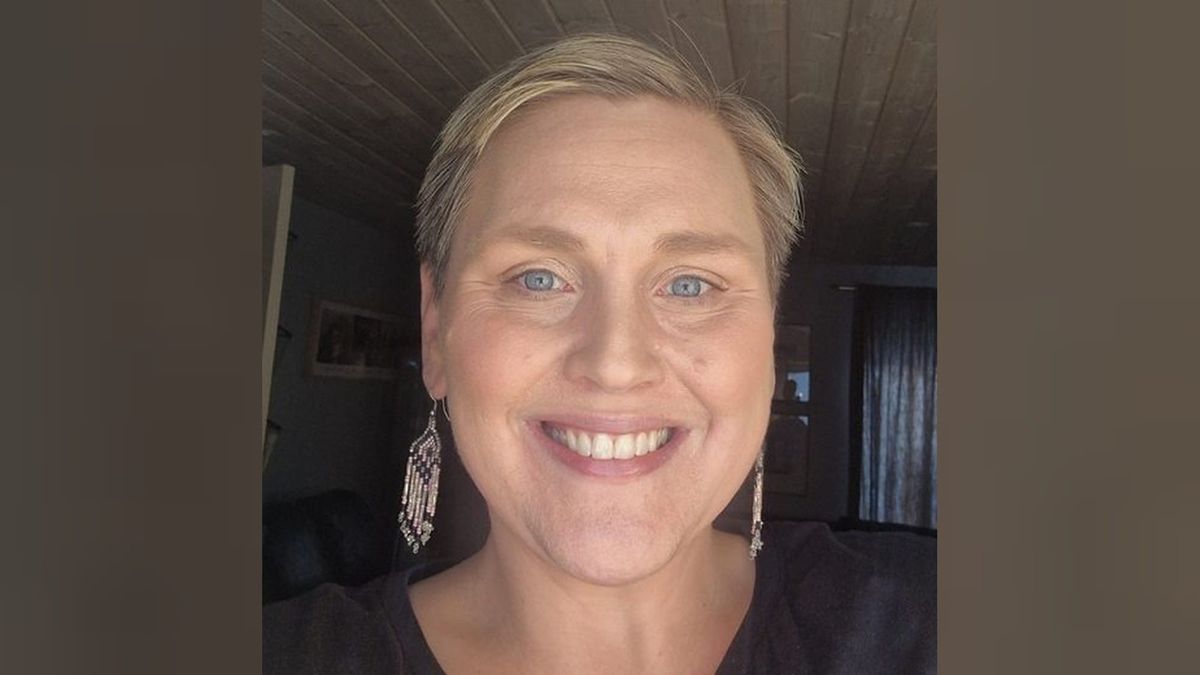
Cynthia Andersson. Photo: private.
Terskelen
Andersson grew up in American Pentecostal churches, where her father was an ordained minister in the Assemblies of God. The fellowship has allowed women to be ordained and to pastor churches since its earliest days, but she never met a woman pastor there, nor in the Church of God, during the 1980s and 1990s. Every congregation she knew was led by men, and the question was rarely discussed. In Sweden she came to small confessional Lutheran churches where women could not vote. She asked where the Bible says that. She has kept asking.
For her the question of women pastors comes last. First come three others: whether you are saved, what you believe about the Bible, and what you believe about men and women. She reads 1 Corinthians 14 as a rule about weighing prophecy, and the office as doctrinal authority before God. Men have not stepped up, she says.
Two questions remain for the editor. She calls the matter secondary, yet could never belong to a church with a woman pastor. Where does the line between first and second things run? And who decides when two confessional churches read the same verses differently, as she has seen? The women in the series have the word.