
Kvinnelige prester. Dialogen · Del 69
María Guðrúnardóttir Ágústsdóttir was six when the first woman was ordained in the Church of Iceland, and disappointed that it was not her. Today she is dean of West Iceland and serves at Reykholt, where Snorri Sturluson lived.
Av Maria Solbak Årnes · Video conversation with the Rev. Dr María Guðrúnardóttir Ágústsdóttir, dean of West Iceland, Evangelical Lutheran Church of Iceland · 5 November 2026
«It's 11.07 in Iceland,» she said when we began. «It's a very dark day. It's a very windy and wet day. So normally I'm having a short service at 12 o'clock, but not today. It's too windy for the elderly people. So I have enough time.»
Daughter of Guðrún and Ágúst
MARIA Why don't you start by telling me where you are in life right now, and where you are serving?
My name is María. I'm the daughter of Guðrún and Ágúst. That's what my last names mean. We don't have family names. We are daughters of our fathers, or sons, and more and more now daughters of our mothers as well.
I have been serving as a pastor in the Evangelical Lutheran Church of Iceland since 1993. I was ordained in January 1993. So it's like 33 years. It's a lot of years. I was 24 when I was ordained, and I was the youngest pastor for many, many years. Usually people are like 25, 26.
I've been serving mostly in Reykjavík. I was an assistant dean, or like a district pastor, in Reykjavík for many, many years, and mostly had my office in Hallgrímskirkja, and it was getting more and more crowded. If we wanted to use the toilet or the kitchen, we had to squeeze through the tourists. The last seven years I was a reverend in a parish in Reykjavík.
But I was brought up, my father was a pastor in the Lutheran Church, a rural pastor. So I was brought up in the countryside. I always wanted to be a country priest. So it just happened that I was in the biggest churches of Reykjavík for many, many years. But then I had the opportunity to go outside.
I live now outside of Reykjavík, like 110 kilometres from Reykjavík. The place is called Reykholt in Borgarfjörður, and most Norwegian people would know it because of Snorri Sturluson and the sagas. This is where the sagas were written. So this is a very historical place, and a big church, the biggest church for a very small rural parish. There are 200 members for this big church.
But I serve in a team of three priests, or pastors, for the area of Borgarfjörður, and we have a little more than 4,000 parishioners. They are very spread around, and we have many small churches. There are like 16 congregations in this one parish. So we are three serving there, and I live in Reykholt.
Fakta
Reykholt. Snorri Sturluson, the author of Heimskringla, the sagas of the Norwegian kings, and of the Prose Edda, moved to Reykholt in 1206 and was killed there on 23 September 1241 by the men of Gissur Þorvaldsson, on the orders of King Håkon of Norway. The research centre Snorrastofa was founded at Reykholt in 1995. The present church at Reykholt was consecrated on 28 July 1996. María Guðrúnardóttir Ágústsdóttir is listed by the Church of Iceland as dean of the West Iceland deanery, Vesturlandsprófastsdæmi. Her doctoral thesis, finished in 2016, is titled Oikoumene as a Practical, Relational, and Spiritual Reality; the title is given by herself. Sources: Store norske leksikon, Snorrastofa, Þjóðkirkjan, Reykholtskirkja.
Some hats
In 2016 I finished my doctoral thesis. I was a little late to start all over in my studies. So I was in my 40s when I started again, and I finished my doctoral thesis on ecumenical theology. I wrote it in English. It's the inter-church connections on a local basis. I made a research about that.
And then, because I'm a doctor, I teach sometimes at the university. I'm now teaching at the theological faculty, along with my service up in Borgarfjörður. And I'm also the rural dean. They would call me Very Reverend Dr María. Rural dean of West Iceland. So I serve in this area of West Iceland. So I have some hats.
MARIA Why did you take a doctor's degree?
Well, I like to study. And I had been serving my church in inter-church connections for 20 years, and I wanted to make something out of that. So it was mostly a personal curiosity. I never really intended to be a professor. I love being a priest, or serving in the church as a pastor.
MARIA What is the most interesting thing you learned?
This is an interview research study. So I was mapping what the people I interviewed see as the most important thing in inter-Christian, and also a little bit inter-religious, relations. And my findings are that relations are the most important thing. The relations are more important often than theology.
Of course, there is difference in theologies between different Christian churches. And the biggest difference now is not really theological, but more ethical. Those difficult ethical dilemmas the churches have been through. In the Lutheran church it's like the homosexual issue. Sweden, of course, has been in the front of this, and the Icelandic Lutheran church was also very early on. We can meet people with all kinds of backgrounds. So we do not ask people what group do you belong to.
But there are other Christian churches that still have a big problem with the gay issue. So this is not really a theological matter, as I see it. It's more a matter of culture and customs and the way people are used to think.
So my findings in my thesis are that the most important thing is to have good relations between churches. And that is almost always possible, but not when it comes to controversial ethical matters. And of course the ordination of women is also one thing that churches in general do not agree on. Not all Lutheran churches ordain women. You would think that all Lutheran churches do that, but they don't. So I would say the difficulties between churches are not really theology. It's more like a traditional way of thinking.
The relations are more important often than theology.
MARIA Did you find any differences between men and women in how they thought about the issue?
Well, I did not really have the space to go into that. It turned out to be almost 300 pages, and it was too long. This was one of the points I pointed out that I would like to have looked at more. I interviewed more men than women, because more men are involved in dialogues between churches. So it was more difficult to find women, to have a gender balance.
A win-win
MARIA What does Christianity in Iceland look like? Is there one large state church? Are people going to church?
The Lutheran Church, ELCI, is the same as in Scandinavia, this evangelical Lutheran. It's not evangelical in the sense of the American evangelical. It's just because Lutheran churches have been called evangelical. The Lutheran Church in Iceland is far the biggest one. The secularization is here as in every other country. The religious institutions are not as popular as they used to be.
We are not a state church as such. It's an independent church, but still it's in the constitution that the state supports the Lutheran Church, being the biggest church of Iceland. And because of very complicated financial things, the state took over lots of church property many, many years ago. So the state pays the salary of the pastors. That is because of the church property that now belongs to the state. I think in ten years or so it will be looked into again: When has the state finally paid back the debt to the church?
But there are mostly friendly relations between church and state, and most people in the government, I would say, think it's positive to have a broad-minded and a broad church that is all over Iceland. And the other Christian churches mostly think so too, that they also benefit from the positive outlook on the Lutheran Church. So it's like a win-win.
The second biggest Christian church would be the Roman Catholic Church, and then we have all sorts of Christian churches and other religious communities. But what's special for Iceland would probably be the Ása religion, the old heathen religion. It is a registered religious community, so it's more than just a cultural club. They are preparing to build a temple up in Öskjuhlíð, very central in Reykjavík. And there are at least two Muslim communities, various types of Buddhists, and the Jewish community is now also registered. So we have more or less all kinds of religious communities.
She wanted to be the first
MARIA What is the position of your church on women in ministry?
The first woman to be ordained in the Evangelical Lutheran Church of Iceland was Auður Eir Vilhjálmsdóttir. That was the 29th of September in 1974. In Denmark it was 40-something. And the Finns, well, not recently, 90-something. But before that, there was an Icelandic lady that was ordained in America, like 100 years ago. She was a doctor and a priest, a missionary in Africa for a Baptist church. But the Lutheran Church of Iceland, that was in 1974. And she's still alive, the first woman to be ordained in Iceland. She's almost 90.
And I was six years old, and I remember this story, because my father was a priest, and my mother and my father were, well, you could probably call them feminists. Gender equality would be a very important thing for both of them, also my father. And they were big supporters of the first democratically elected female president in the world, that was in Iceland in 1980. They were involved in her campaign, and I grew up with this worldview that women could do everything.
So I had decided to become an ordained minister. At the time this lady was ordained, I was six years old. And I was a bit disappointed, because I wanted to be the first. So this is a funny story. But I was only six. They should have waited for 20 years. So I grew up with this, even though there were no role models in Iceland. I think I was two or three when I decided I would become a minister. So it was very early on.
I was a bit disappointed, because I wanted to be the first.
Fakta
Women in the Church of Iceland. Auður Eir Vilhjálmsdóttir was ordained on 29 September 1974, the first woman in the Evangelical Lutheran Church of Iceland, and took up her first post in the fishing village of Suðureyri. In 2012 Agnes M. Sigurðardóttir became the first woman elected Bishop of Iceland, and she held the office until 2024. Guðrún Karls Helgudóttir took over the duties on 1 July 2024, the second woman to lead the church. Sources: Lutheran World Federation, Wikipedia, Auður Eir Vilhjálmsdóttir, Wikipedia, Bishop of Iceland, Wikipedia, Guðrún Karls Helgudóttir.
God loves you
MARIA Did you get an inner calling at that age?
Well, no, I don't think so. I think it came from my parents. And there was this elderly lady, she was very poor and living in this old, wretched house, and had no teeth, a very special old lady where we lived. And she would always call me Reverend María, Séra María. So it came to me before I decided myself.
And later on I had a calling. I was maybe 18, and I had just graduated from the gymnasium. I lived in Denmark, you see. And every other Danish kid, after graduating from the gymnasium, would go to France. Today they go to Asia or something. So I went there, and I had a lot of friends from Denmark, and we went to the Danish church.
And I was having this identity crisis: What should I do with my life? As some people experience at that age, just before they turn 20. I'm also musically trained, so I was thinking about becoming an organist, maybe, or a choir director. All the possibilities in the world were open for me. So it was a bit difficult. But I always had this with me, that I wanted to be a priest.
So I went with those friends of mine in Paris to the Danish church. Those young people would never go to church in Denmark. But in Paris they liked to come to the church, because there was a club for young people. So we went to this service, a beautiful April Sunday morning, and they were playing a trumpet or something. It was a very nice service.
And then I just felt it. I should not go over the stream to fetch the water, as we say in Icelandic. So of course I should be a priest. Why not? I needed to go away from it a bit, to really come back to it.
And I felt this calling, because this Danish pastor was saying goodbye to the congregation in Paris. And what I heard him say, probably he said many other things as well, but I only heard what he said: that God loves you. It was very simple. It just came to me like that. And then I thought: This is what I want to do in my life. I want to go and tell people God loves you. So this was, in a way, a simple and beautiful calling. And I started right away on my theological studies at Copenhagen University. And then I moved back home to Iceland, because I wanted to live in Iceland, not in Denmark.
I want to go and tell people God loves you.
Nobody would say out loud that women should not be pastors. So, I do not have the numbers right, so don't quote me on numbers, but I think around half of the Icelandic priesthood in the Lutheran Church would be women. And where I serve, we are three pastors together. We are all women. My mother said: Oh, you're all women, there's no man. But there have been three men serving together for so many years. So why not three women now? But of course it's good to have the balance, that we have all kinds of people. It's more the persons. How do the persons function together? I think that's most important.
Cultural glasses
MARIA Since you like reading and studying, have you studied the passages that are used when people argue against women in ministry?
I have, yeah. What the Apostle Paul says about women being quiet in the gatherings is, of course, a cultural thing. Like I said before, I think we have to set a line between what is theological and what is cultural.
It is a cultural thing at Paul's time. What Jesus did was exceptional. He would speak to women, not only women he was allowed to speak to, but also women that were not. Men should not speak to women, and men should especially not speak to women that were outside of the Jewish community. Like the lady from Samaria, at the well. So Jesus broke all the rules about gender back in his time.
But Paul needed to settle some of the issues. He needed to have more of a frame, and for people in the new Christian communities, this was so new, that women were allowed to even speak publicly. So this I read with the cultural glasses on. He was not as broad-minded as Jesus was. So I like to listen to Jesus more than Paul the Apostle.
And then also in some of the letters. I think what Paul writes in 1 Corinthians is about the special situation in Corinth. There were some controversies, and he needed to calm them down. But in other places he writes to women who are leading house churches, and we have examples of that in the New Testament. Lydia, for example, was leading a house church, and probably those women would have been widows with their own households. They had a special status.
So probably there were women deacons and women leaders in the first Christian communities. And I have also studied how they were quieted. They were made to step down because of the pressure of the male community. They did not want women to lead over them, or be in a higher position. So I think that maybe the first Christian communities were more broad-minded, like Jesus was, than what came after, when women were put in their place.
So this I read with the cultural glasses on.
MARIA Paul sometimes writes, «This is my opinion», and other places, «This I have from the Lord». And in First Timothy he points to creation as the reason why women should be subordinate, as something given by God that is good for people. Do you agree that this is his argument?
Well, one place he is talking about widows and widowers: I think they should marry, that would be better, but that is my opinion. So sometimes he says, this is from me, and this is from God. But of course Paul was not God. He was not Jesus Christ. He had a very, very bright mind, and of course was under the influence of the Holy Spirit. But what Paul says is not necessarily the right thing. Because the Bible is written by so many people over such a long time, and it reflects so many cultural milieus.
And of course the two creation stories in the Bible, in Genesis 1 and 2, are stories where people are trying to answer the question: What is the meaning of life? People have always tried to answer that question. And we see it in other religions, also in the Ása religion, this story about how it all came to be.
The first creation story of the Bible is a very equal one. It is not feminist, and it's not an especially masculine view. God created man as man and woman. So it's very equal, and gender neutral. It only says two genders because we hadn't found out all the genders back then. But the second creation story is the one that has been used to degrade women, that women came from the rib of Adam. The one with the rib probably stems from an older time. But they're both trying to answer the question: How did this come to be?
And I have read articles about how women are taken from the side of Adam, not under him or above him, not from his head or his feet, but from the side, where the heart is. So this is also a beautiful interpretation of the second creation story.
In general, Lutheran churches follow Martin Luther in his view that not all of the Bible is the same. We cannot value every single word in the Bible as having the same value. Lutheran theology would say that the words of the Bible are all important, but they are not all pointing to Jesus. This was the rule of Martin Luther, that the Bible should point to Jesus Christ. And if it does not point to Jesus Christ, then it has less value than that which points to Jesus Christ. So this is like a rule of reading the Bible for us Lutherans.
Not from his head or his feet, but from the side, where the heart is.
MARIA I recently read that Luther also meant you should read the Bible with the Bible.
If there's something you don't understand, you can always find a Bible passage that will explain it for you. This is also a very good rule. And I love Bibles that point to other Bible verses. So I can always check: This has the same theme, maybe I will understand it better.
So what I'm trying to say is, not everything Paul wrote is the whole truth and nothing but the truth. It has this cultural bias to it.
MARIA But I don't get how we decide what is cultural and what is not.
When it comes to gender issues and sexual issues, it helps when you know your history, how women were treated at the time of the writings. So you can see what reflects more the cultural thing, what people were used to.
And also, when it comes to homosexuality, Jesus never said anything about homosexuality. Nothing. He only spoke of love. So that means to me that I have to have love as my guiding light, not some kind of cultural rule from my own time, or from Paul's time, or from Old Testament times. So this is not as hard as you think, to decide what is cultural and what is not. When you read the Old Testament, there are all those rules about food, for example. I think very few Christian congregations would follow the strict food regulations of the Old Testament, because it's a cultural thing.
MARIA But Jesus and Paul did renew those rules, didn't they? They said you can eat all food.
But Paul came after Jesus, so Jesus couldn't correct Paul. But he did that beforehand, by speaking with women and listening to them.
MARIA I find many similarities between Paul and Jesus. I read Paul as quite progressive when it comes to women. He writes about many women who help him build churches and spread the Word, and he gives them credit. And he writes that men and women, slave and free, Jew and Greek are the same before God. And Jesus lets women be his first witnesses.
Yeah, women were the first witnesses to the resurrection of Jesus. And Martha, the sister of Mary, has a very profound confession in John 11. So this is not a question in my mind.
No man has ever said it
When I've been to conferences with more conservative Christian churches that would not allow women to be ordained, only once, maybe twice, when I was a very young pastor, I met an elderly lady. And she said to me: I don't think women should be priests. I don't like that. And another one, maybe. Those were two elderly ladies, like 30 years ago. And no man has ever said that to me, that I should not be a priest. So I was astounded that it was this old lady. She just told it to me right in my face. I was very young and sensitive. But that was just because she was not used to it.
Now we have a female bishop, the Bishop of Iceland, our second female bishop. And now we have our second female president, and our prime minister is a lady, and the mayor of Reykjavík is a lady, and many of the ministers. So in Iceland this is not a problem for us. We just expect people to be good workers and decent and true to themselves and what they're working on. More or less. Of course you can hear people say: Well, everybody leading us now is a woman. It goes back and forth. But I don't feel any resistance to my ministry, being a woman. It's normal for people in Iceland.
And no man has ever said that to me, that I should not be a priest.
Six women and six men
MARIA Several people I have interviewed argue that even though Jesus broke the rules and spoke with women, and women like Mary Magdalene followed him, he did not choose women as his apostles. He chose twelve men. So the higher link between the congregation and God should be a man. What do you think?
It would have been too radical for his time if he had chosen women to be in front. There were many of them following him, and they were part of the group of disciples, but the apostles, those who were sent out, they were all men. And this is also a cultural thing, because a woman's voice was not listened to. Women were not at that time allowed to bear witness in a law case, for example. So when a woman came and said something, it was not valued, and it was not listened to. So the cause of Christianity would not have benefited from him choosing six women and six men.
But he still did that in this other way, the women being the first witnesses of the resurrection. Of course, Jesus did not speak of Christianity as such. That came soon after his resurrection. But women would not have been listened to as official representatives of what was to come. So this was a very wise decision.
But I've also heard the argument that Jesus himself was a man. So if priests are officiating on behalf of Christ, they of course have to be men. But in my eyes, as with the disciples, this is a completely insufficient argument. Because if he had been a woman, he would not have had the chance to speak publicly as he did. He would not have been listened to. So he had to be born as a man, because that was the only way for God to reach people, because of the cultural surroundings.
God is a wise God. God uses means that are possible and understandable to man. There are a lot of things that we do not understand, but as understandable as possible. And Jesus being a man was necessary for that cause, as were the apostles. So for me, Peter's confession and Martha's confession are equally important, and they are both reported in the New Testament.
The stories of Peter, who was not always a very wise man and did things without thinking, make me believe more in the authenticity of the New Testament. Because if they had wanted everything to be bright and beautiful, they would have taken out passages that did not put Peter in a good light. As in the Old Testament, King David, the big psalmist, is not always put in a very positive light. He did terrible things. They tell stories about people that were not perfect.
So in my view, what we hear about Martha is more perfect than what we hear about Peter. But still she had to work behind the scenes more than publicly, because she would not have been listened to. Women were less valued than men, and that was the time, as it was. But Jesus' example tells us that he always intended that to change. It did. It took a long time, but it did change things.
So the cause of Christianity would not have benefited from him choosing six women and six men.
The language of love
MARIA Submission is mentioned many places in the Bible in a positive way: submission to God, the Son under the Father, and also in marriage, that if the man has Christ as his head, the woman should have her husband as her head. Do you think there is a God-willed order?
I'm 58 years old. I have lived a rather long time, and I have seen many marriages and many relations, and I am totally convinced that men are not always right. And I'm sure that most men would agree with me that nobody can always be perfectly right. So the submission thing is also a cultural thing, in my view, because it had a totally other meaning back then.
Men had multiple wives. Sometimes in the Bible it would be allowed to have more than one wife, as it still is today in some parts of the world, and it was more practical that the husband should decide, because the wives were so many. And of course this male-dominated culture, it was a very nice thing to be a man and be allowed to do anything you wanted. But I don't think it has always been that nice for a man to be the one who should always decide. That can be a very difficult position as well.
The marriages I have seen that function more or less nicely would have two people who decide together. And sometimes the wife would decide everything, and that is not a good thing either, because both would be unhappy. The person in the marriage who is always deciding, it's also an unhappy position to be in. The happiest marriages I have seen are where people can discuss, and take action together, and decide together.
So I don't think this is a godly given thing. I think it's in the cultural aspect of the Bible. It was a practical thing that the man should decide. With all the childbirths, a woman who is always pregnant or breastfeeding, or has many children to look after, you had to have some kind of a system to make it work, to make all those children survive. You needed the husband out there to fetch the food, and the mother at home to take care of the children. This is a totally different world we have today. So I think sometimes it has been a good thing, but it is not applicable to our world as it is today.
In Christian theology we see the three persons of the Trinity, the Father as the source, the origin of the Son and the Holy Spirit. So you could say that God the Father was somehow more important than the Son and the Spirit, but it is not so. We are trying to put words on what God is. Of course we cannot. Nobody knows. We are just using the words that we know.
For me, I had a very loving father, so for me it's natural to say God the Father. My mother is more strict, so it's not the typical gender roles I grew up with. But people of all genders could have had an abusive father, and for them it's difficult to pray to God the Father, because the word has bad connotations. For some people it would be better to say mother. So our words can be so difficult, because we all have different experiences.
That's why Paul says that Jesus is submissive to the Father, because the creator God is the source. But that does not mean Jesus is less valued. We have the Nicene Creed and the Apostles' Creed, and it took many hundred years to find out how to put this into words in light of the Bible. It is very well underlined that the three persons of the Godhead are all equal, but they have different roles, and they have this loving communication between them. Augustine, on the western side of theology, would say that love is the language of the triune God. So it's not that somebody is less valued if you speak the language of submission. It's not about value.
Love is the language of the triune God.
MARIA You said equal but with different roles, like in the Trinity. But that doesn't go for men and women in marriage?
I think it's a good thing that we force our brains to think that there are many kinds of people. Men are not always like this, or women like that. We all have feminine and masculine traits. Some women like to be out there cutting the trees, and the husband would be cooking the food, just because people are different. And it must be horrible for men also, to be put into this box: You have to be hardworking because you're a man.
I often read biographies where there was this young man growing up in the countryside, and everybody expected him to become the farmer when his father would die, but all he wanted was to be a poet. He did not want to be in this box that the generations before him had put on him. So I think it's good for us just to let us out of the boxes.
MARIA You described a crisis in your own life at 18, with so many choices. Can it also be a good thing to have some boundaries or expectations to hold on to? Some safety?
Well, that can be a good thing. It's always good to have guidance, and often if your parents are teachers, you become a teacher, because your environment molds you. So expectations can also be good, and you learn from your parents. The boundaries just must not be too heavy on you.
So I think also with this submission thing, people are just so different. In some marriages it would be the woman who takes the lead in some matters, and maybe the husband in other matters. But if you're not the strong type, why should you have to be the strong type, only because you were born a man? I think it can be a lot of pressure on people. But of course guidance is always good. You will always find someone to give you some guidance. That's what us priests are for, among many other things. But not to be put in a box.
That's what us priests are for, among many other things. But not to be put in a box.
Psalm 34
Before we said goodbye, Maria asked her, as she had asked the dean in Nuuk, to read a passage from the Bible in her own language. «I'll just fetch my Bible.» She chose Psalm 34, from the Icelandic translation of 1981, and read the first nine verses.
Sound clip
2Ég vil vegsama Drottin alla tíma, ætíð sé lof hans mér í munni. 3Sál mín hrósar sér af Drottni, hinir hógværu skulu heyra það og fagna. 4Miklið Drottin ásamt mér, tignum í sameiningu nafn hans. 5Ég leitaði Drottins, og hann svaraði mér, frelsaði mig frá öllu því er ég hræddist. 6Lítið til hans og gleðjist, og andlit yðar skulu eigi blygðast. 7Hér er volaður maður sem hrópaði, og Drottinn heyrði hann og hjálpaði honum úr öllum nauðum hans. 8Engill Drottins setur vörð kringum þá er óttast hann, og frelsar þá. 9Finnið og sjáið, að Drottinn er góður, sæll er sá maður er leitar hælis hjá honum.
«This is a lot of work you have ahead of you,» she said at the end. And then: «Blessings to you.»
Portrett
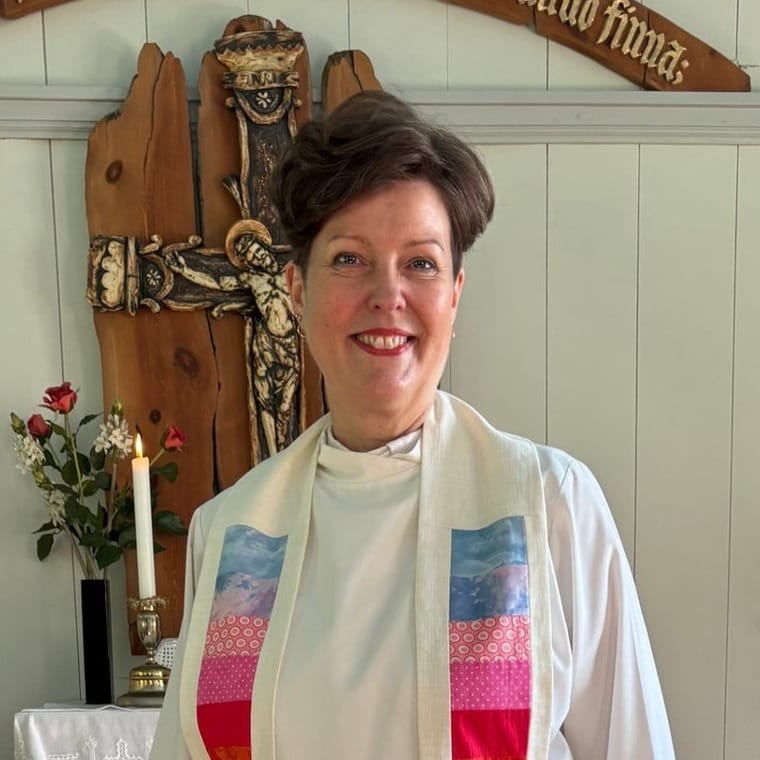
The Rev. Dr María Guðrúnardóttir Ágústsdóttir, dean of West Iceland. Photo: Private.
Terskelen
María Guðrúnardóttir Ágústsdóttir grew up in a rectory in the Icelandic countryside with parents who campaigned for the world's first democratically elected woman president, and she decided to become a minister before she could read. Her calling came at eighteen, in the Danish church in Paris, in three words: God loves you. In more than thirty years as a pastor, she says, no man has ever told her she should not be one.
She reads the Bible as a Lutheran, by what points to Christ, and she reads Paul with cultural glasses on. The silence in Corinth answered a local quarrel, the apostles were men because a woman's witness carried no weight in court, and the order in marriage was a practical arrangement for a world of many wives and many children. In the Trinity she sees three persons equal in value with different roles, joined by love.
The editor takes one question with him. Her thesis found that good relations between churches are almost always possible, but not on controversial ethical matters, and the ordination of women is one that churches do not agree on. The two sides of this series disagree on it. What has she seen keep a relation alive when the disagreement does not go away? We thank her for sharing this with us.